What Happens During a Professional Rubbish Removal Collection Visit
Removing unwanted items from a home, rental property, commercial premises or managed site can seem straightforward until the amount of material begins to build up. Large furniture, old household belongings, renovation debris and general clutter can take considerable time and effort to move, particularly when access is restricted or several different types of material need to be handled.
Professional rubbish removal provides a structured way to deal with unwanted items without requiring customers to organise every stage themselves. From the initial booking through to loading and clearing the collection area, an organised service can make the process considerably easier for homeowners, landlords, surveyors, local authorities and those responsible for residential or commercial properties.
For customers in Croydon and surrounding areas, understanding what happens during a collection can also make it easier to prepare. Access can vary considerably between residential streets, flats, commercial properties and larger managed sites, so providing accurate information before the team arrives is helpful. The volume and type of material, parking arrangements, stairs, entrances and the distance between the waste and the collection vehicle can all influence how the job is approached.
Although every property and clearance is different, professional collections generally follow a clear sequence. Knowing what to expect can reduce uncertainty, help the team work efficiently and ensure unwanted materials are dealt with in an organised and responsible manner.
Preparing for the Team Before They Arrive
Good preparation can make a rubbish collection significantly easier, particularly when a property contains a mixture of bulky objects, bagged materials and smaller unwanted items. Customers do not necessarily need to move everything outside beforehand, but identifying what needs to go and providing clear access can help the collection proceed efficiently.
Identify What Needs Removing
- Walk through the property or site and decide which items are being taken away before the team arrives.
- Separate belongings that need to remain so there is little risk of confusion once loading begins.
- If several rooms are involved, explaining which areas contain unwanted items can help the team plan the collection.
- Landlords and property managers may find it useful to check cupboards, storage spaces, garages and gardens so overlooked items do not remain after the main clearance.
Provide Accurate Information
- Give a realistic description of the amount of material when arranging the service.
- Mention particularly large or awkward objects, such as wardrobes, sofas, desks or bulky outdoor items.
- Explain whether the property has stairs, narrow entrances, lifts or restricted access.
- For larger residential or commercial clearances, photographs or a detailed description may help the provider understand the likely scale of the work before arrival.
Consider Vehicle Access
- Check whether the collection vehicle can stop reasonably close to the property.
- Where parking is restricted, provide relevant information when making the booking.
- Flats, town-centre properties and commercial premises may require additional planning because loading areas can be limited.
- Keeping entrances and pathways clear allows the team to move items more efficiently while reducing unnecessary obstruction.
Organise Loose Materials
- Small objects can often be grouped together so they are easier to handle.
- Where appropriate, lightweight loose materials may be placed into suitable bags or containers before collection.
- Avoid creating bags or containers that are unnecessarily heavy, as they may become difficult to move safely.
- Keeping different areas organised also makes it easier to confirm that everything intended for removal has been collected.
Mention Unusual Materials in Advance
- Not every type of material can necessarily be handled in the same way, so unusual items should be discussed before the booking.
- Customers should explain what they intend to dispose of rather than assuming everything can automatically be taken.
- Early communication allows the provider to advise whether particular materials require different arrangements.
- This is especially useful during renovation, maintenance or commercial projects where the waste produced may differ from ordinary household clutter.
Preparation does not need to become another large job in itself. The aim is simply to give the collection team enough information to understand the property, access arrangements and volume involved. A few practical steps beforehand can save time on the day and make the experience easier for everyone involved.
What Happens When the Collection Team Arrives?
Customers searching for rubbish removal near me may understandably want to know what actually happens once a professional team reaches the property. In most cases, the first stage is not immediately loading the vehicle. The team will normally need to understand what has been agreed, inspect the items and confirm how they can be moved from the property efficiently.
On arrival, access is usually one of the first practical considerations. At a suburban home this might be relatively simple, with a driveway or accessible front entrance. At a flat, terraced property or busy commercial location, the team may need to consider stairs, communal entrances, narrow passages or the distance to the vehicle. These details affect how the collection is organised rather than changing the fundamental purpose of the service.
The customer can then identify the items that need to be cleared. This stage is particularly important when unwanted objects are positioned alongside belongings that are staying. Clear instructions help prevent confusion and allow the team to establish a sensible loading sequence.
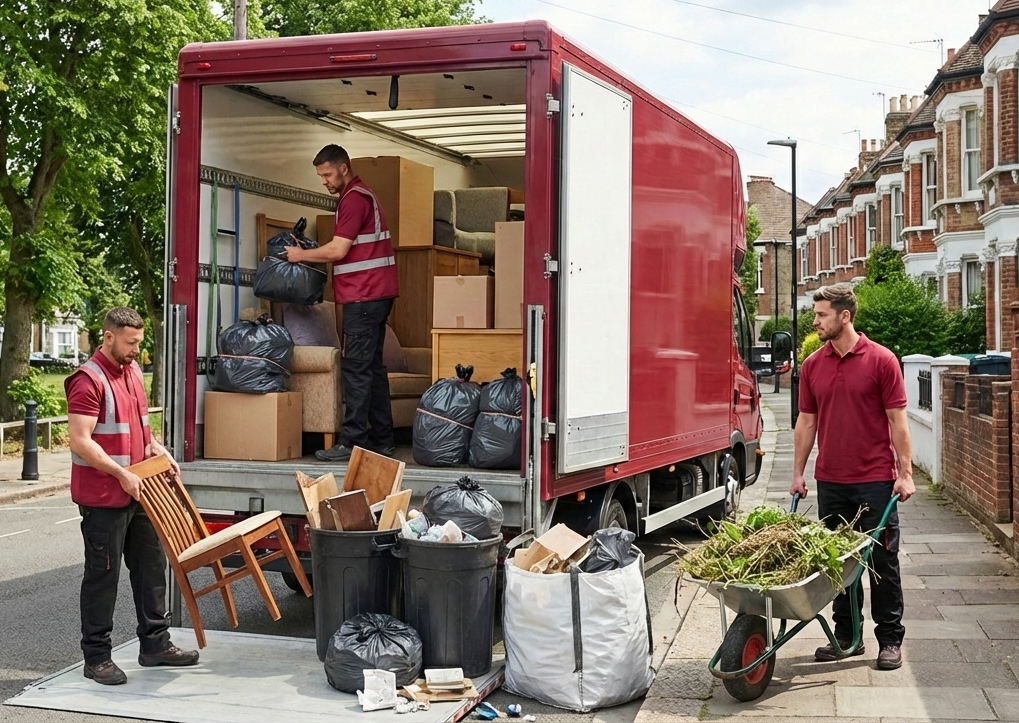
Large and bulky items may be handled first or moved according to their position within the property. The exact approach depends on access, weight and the mixture of materials involved. A sofa located close to the front entrance, for example, presents a different challenge from furniture being removed from an upstairs room. Similarly, an office clearance involving desks, shelving and miscellaneous contents requires different planning from a small garden tidy-up.
Professional teams generally work methodically rather than moving everything at once. Creating a clear route between the unwanted items and the vehicle helps reduce obstruction. As material is removed, additional space becomes available, which can make subsequent loading easier.
For landlords, agents and those overseeing vacant properties, the collection may involve several rooms. It can be useful to complete a final walkthrough once the main items have been moved. Cupboards, loft spaces where accessible, sheds and storage areas can easily be forgotten during larger clearances.
Commercial premises may require a slightly different approach. Work may need to take place around staff, customers, contractors or other site activities. Clear communication becomes particularly important so that collection work does not unnecessarily interfere with normal operations.
Once the agreed items have been loaded, the immediate collection area should be checked. The objective is to ensure that the materials identified for removal have been dealt with and that nothing intended to remain has been taken accidentally.
The process is therefore more organised than simply arriving, loading objects and leaving. Assessment, communication and careful handling all contribute to a collection that works efficiently for the customer and the property.
How Items Are Sorted, Loaded and Managed
Once the collection has been confirmed, attention turns to handling the materials efficiently. A professional waste collection should take account of the types of items involved, their size, how they can be moved safely and the most practical way to load them for onward processing.
Bulky Furniture
- Sofas, tables, wardrobes, shelving and other large pieces often require careful manoeuvring through doorways and corridors.
- The team may assess the easiest route before moving particularly awkward objects.
- Where several large items are being removed, their loading order can help make effective use of vehicle space.
- Customers can assist by ensuring entrances and internal routes are free from unnecessary obstacles.
General Household Contents
- Bags, boxes, old belongings and miscellaneous clutter can make up a large proportion of a domestic clearance.
- Grouping similar items where practical helps create a more organised collection.
- Smaller materials may be loaded around larger objects to make sensible use of available vehicle capacity.
- A systematic room-by-room approach can be useful when clearing larger homes.
Renovation and Property Materials
- Refurbishment and maintenance work can produce timber, old fittings, flooring, packaging and other unwanted materials.
- These projects often generate waste gradually, so deciding when to arrange a collection can help prevent working areas from becoming overcrowded.
- Customers should describe renovation materials accurately when booking so the provider understands what is involved.
- Keeping debris contained before collection can make the site easier to navigate.
Garden and Outdoor Materials
- Garden projects can produce branches, cuttings and other bulky material that occupies substantial space despite sometimes being relatively lightweight.
- Fencing, old garden furniture and miscellaneous outdoor items may also form part of a property clearance.
- Keeping garden waste in an accessible location can simplify removal.
- Larger landscaping work may benefit from planning collections around different stages of the project.
Commercial and Managed Properties
- Office furniture, packaging, shelving and general unwanted contents can require organised removal from commercial premises.
- Collections may need to be coordinated around opening hours or other contractors.
- Surveyors, property managers and local authorities may have several areas requiring attention within one site.
- Identifying priorities before work begins helps the team follow a clear collection plan.
Responsible Handling
- Materials may need to follow different routes after leaving the property depending on their type and condition.
- Suitable items can be separated for appropriate processing or recycling where facilities allow.
- Organised handling helps prevent different materials from becoming unnecessarily mixed.
- Customers can support the process by providing accurate information about the contents before collection begins.
A structured approach to sorting and loading becomes increasingly important as the scale of a clearance grows. What may seem like a random mixture of unwanted objects can usually be managed much more effectively when items are considered by type, size and handling requirements.
What Happens After Everything Has Been Loaded?
Once the vehicle has been loaded, the physical work at the property may be nearly complete, but there are still several important stages to consider. Customers often focus primarily on getting unwanted items out of their home or workplace, yet what happens afterwards is also part of a well-managed service.
Before departure, it is sensible to check the original collection areas. This provides an opportunity to confirm that all agreed items have been removed. During larger property clearances, it is surprisingly easy for a small pile in a side room, garage or storage area to be overlooked. A quick final inspection can prevent the inconvenience of discovering remaining material later.
The site should also be left reasonably orderly following the loading process. The exact condition will naturally depend on the type of work involved. A property undergoing major refurbishment will not resemble a completed home, but removing the agreed unwanted materials should create noticeably more usable space.
Customers who initially search for waste removal near me are often trying to solve an immediate practical problem, yet responsible onward handling is also worth considering. Once collected materials leave the property, they may need to be sorted or directed towards appropriate processing facilities according to their type.
Recycling can form part of this process where suitable routes are available. Metals, timber, cardboard and other materials may have potential for further processing rather than simply being treated as one undifferentiated load. The exact destination depends on what has been collected and the facilities available.
This stage highlights why providing accurate information at the beginning is valuable. If the collection team knows what materials are involved, the job can be planned more effectively from arrival through to onward handling.
For landlords and property managers, completion of the collection may allow cleaners, decorators or maintenance contractors to begin their work. For homeowners, it may mean reclaiming a garage, spare room or garden that had become difficult to use. Commercial customers may be able to return cleared areas to productive use or continue with the next phase of refurbishment.
Timing can therefore be particularly important. Arranging the collection at the right point in a project helps avoid clearing materials too early and then generating another large pile, while waiting too long can allow waste to obstruct working areas.
A professional collection should ultimately leave the customer with a clear understanding that the agreed job has been completed. From the first enquiry to the final check, each stage contributes to a more straightforward experience.
Rubbish Removal Croydon provides a practical service for customers who want unwanted items cleared from residential and commercial properties in an organised manner. We understand that every job has different requirements, from straightforward household clearances to larger projects involving landlords, surveyors, businesses and managed properties.
Our approach to rubbish removal focuses on clear communication from the initial enquiry onwards. Understanding the type and approximate volume of material, property access and any bulky items involved allows the collection to be planned more effectively. Customers can explain their requirements beforehand so that there is a clear understanding of the work expected when the team arrives.
We aim to make arranging rubbish removal straightforward while providing helpful guidance about preparation, access and suitable materials. From the initial booking through to the final check after loading, the focus remains on providing a dependable, well-organised service that allows customers to clear unwanted items and move forward with their property or project.
Check out our latest X update explaining what happens during a professional
rubbish removal collection visit!
You might also like